
How Much Honey to Use
When you decide to start making your own recipes, you may be wondering
how sweet the drink will be. This depends on the amount of honey and
the type of yeast used.
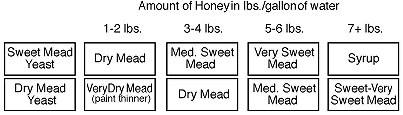
For the purposes of the following chart, wine yeast can be considered
equal to dry mead yeast. Ale yeast can be considered equal to sweet
mead yeast.
This chart assumes a 5 gallon batch. For example: if you used 6 lbs. of
honey/gallon (6 lbs. X 5 gallon batch=30 lbs. honey) and used a dry
mead yeast, you would end up with a medium sweet mead (one with lots of
alcohol, by the way). If you used a sweet mead yeast with this amount
of honey you would end up with a very sweet mead.
Note:
when a recipe says to use 5-6 lbs. of honey per gallon, that means 5-6
lbs. honey and enough water to make a gallon. Not 5-6 lbs. honey and a
gallon of water.
Note: this chart does not take
into account the sugars derived from any fruit or malted barley added
to the mead. This chart is for straight meads only.
Bottling Techniques
Still Meads
If you choose to bottle your mead still (noncarbonated), you will need to take some precautions. The last time you rack
your mead, you should get very little sediment, and no evidence of
fermentation. If the mead is still cloudy, outgassing when shaken, or
noticeable sediment is being produced (over several weeks, needless to
say), then it's not ready to bottle.
Once the mead is truly
done fermenting, de-label and clean thirty 750 ml. wine bottles. Five
gallons of mead will fill 24 - 750 ml. wine bottles, but I always
prepare a few extra bottles.
Sterilize the bottles, then fill with them with mead with the bottling
cane. If you fill the bottles to the top, then withdraw the bottling
cane, you will get the correct amount of head space (space from the top
of the liquid to the top of the bottle).
Put 24 corks in a sauce pan of water, and heat. When the corks are just
slightly soft, they are ready to use. Drive each cork in with a corker
until the top of the cork is even with the top of the bottle. A
standard wine bottle takes a #9 cork. Always use fine grade corks.
Things to Know About Corks
-
After you bottle, store the bottles upright for two days. This lets the corks harden. Then store the bottles on their sides to keep the corks wet. If you don't, the corks will dry out and shrink. This will let air in and will turn your mead into garbage rather quickly. Store your meads at room temperature.
-
If you have a problem with corks coming out, your probably boiled the corks until they were too soft. Or, you have wine bottles with the wrong size necks. I always check new wine bottles to see what size the opening is (the second joint on my little finger just fits into a #9 opening). Or fermentation wasn't done, and you've got pressure in the bottles. If this is the case, sterilize a fermenter and put the mead back in (with a airlock of course) and let it ferment until it's done.
-
If you still have problems with corks coming out, do this: when you cork the bottles, drive the corks in so that they are about 1/4" below the top of the bottles. Fill this space with sealing wax. You can store bottles sealed this way standing upright.
Sparkling Meads
Sparkling Sweet Meads
For a sweet sparking mead, here's how to bottle it. While the mead is
still fermenting just slightly (one blip of the airlock every 30
minutes), bottle in champagne bottles. You prepare the bottles the same
way as with regular wine bottles. As mentioned before I sterilize my
bottles in a dishwasher (full heat cycle). Fill the bottles with the
mead. While you are doing this, place 25 plastic champagne corks in
bleach water and let them soak for at least 20 minutes. Rinse the
plastic corks off, and insert them firmly into the champagne bottles.
Some times you may need to use a rubber mallet to get them in
completely. Do this carefully. Once the corks are in, wire them down
with champagne wires.
Let the bottles set out at room temperature for two or three weeks.
Open one bottle and judge if it's over or under carbonated. If it's
over carbonated or just right, store the bottles refrigerated. If it's
under carbonated, let the bottles set out for a few more weeks and test
again. Don't recap the opened bottles, drink them instead. If the mead
is very over-carbonated, put it back in the fermenter and let it
ferment for a few more weeks and bottle again.
Fermenting the mead in the bottle to carbonate is called bottle
conditioning. Some additional fermentation will take place in the
bottles. Since the C02 can't escape, it will go into solution and
carbonates the mead. Bottle conditioned meads will have a small amount
of yeast sediment in the bottom of the bottles. You don't need to worry
about autolysis of this yeast, as there is such a small amount in each
bottle. Also, some research has shown that a small amount of yeast in
the bottle aids in stability, and extend the shelf life of the mead.
Do not add any additional sugar to a sweet sparkling mead at bottling
time as you do with beers. If you do, you will likely end up with glass
hand grenades.
Sparkling Dry Meads
If you are making a dry (low sugar) sparking mead, do this: when the
mead is completely done fermenting, boil 7/8 cup of honey or 1-1/4 cup
of malt in a pint of water for 15 minutes and add it to your bottling
bucket. Add the mead to the bottling bucket and bottle in champagne
bottles. Since the mead is dry (no or very little sugar left), the
added sugar will produce the right amount of carbonation. The amounts
of honey or malt listed above is for a 5 gallon batch. For a larger or
smaller batch, you will need to use a proportionally larger or smaller
amount of these sugars.
Kegs/Casks
Of course, you can also keg your meads. Five gallon stainless steel
"corney" kegs (soft drink syrup kegs) are a good choice. You can
purchase these kegs, a C02 bottle, tubing and regulator at your brew
shop. For the large scale mead maker, 15 gallon steel beer kegs are
available. However, they use a different style of connecter than the 5
gallon corney kegs, so it's best to settle on one or the other size (I
use both sizes myself).
The biggest point against using kegs is: you can't hand someone a small
amount of mead to take home. It's also hard to send a portion of a 5
gallon keg along with someone else to an event you aren't attending.
This is why I bottle most of my meads, rather than kegging them.
Wooden casks can also be used for storing your meads. However, their
use is beyond the scope of this work. Needless to say, wooden casks
have the same points against them as kegs. Also, they are hard to
sterilize.
Labeling Your Meads
Make your labels however you wish. The labels you have seen in this
work were produced using Adobe PhotoShop, MacroMedia FreeHand and
several other programs.
A good looking label will enhance the experience for whoever drinks
your mead. While you can label your mead with masking tape and a black
magic marker, this tends to make the whole thing look like a amateurish
effort. After all, when you have gone to all the trouble to produce a
quality mead, you should present it in a nice looking bottle with a
informative and cleanly designed label.
However you make your labels, here is one method for attaching them to
the bottles: place a sponge on a plate. Soak the sponge in water and
put about a tablespoon of white glue on top of the sponge. Work the
glue in (mixing it with the water in the sponge). Press the label onto
the sponge, then onto the bottles. Add more glue and water as needed.
The advantage to this method is that the labels are easy to remove when
you want to reuse the bottles. The disadvantage to this method is that
the labels are easy to remove when you don't want them to come off.
Storing Your Meads
Storage of Still Meads
If you have bottled your still mead in wine bottles with corks, it's
best to store these meads on their sides. This keeps the corks wet. If
the corks dry out, they will shrink (and possible be pushed out by the
weight of the mead behind them). If you have waxed the tops of the
corks after you inserted them, you can store the bottles standing up.
If you have bottled in flip top or beer bottles, you can store these
bottles standing up or lying down. Store your still meads at 55-70 deg.
F.
Storage of Sparkling Meads
If you have used beer bottles or champagne bottles with corks and
wires, you should store your mead standing up at refrigerator
temperature.
Aging Your Meads
When you use the shaker method and yeast energizer/nutrient to
accelerate the fermentation of your mead, the need for long aging is
reduced or eliminated. The only types of meads which will need more
than a month or two of aging are:
-
Braggots
Braggots will tend to need 4-6 months of aging for medium strength braggots (2 lbs. honey/Malt per gallon). Strong braggots will need from 1-5 years of aging. -
Ginger Meads
If you use a little ginger (1/4 - 1/2 oz. in a 5 gallon batch) age the mead 2-4 months. If you use a lot of ginger (1-4 oz. in a 5 gallon batch) age the mead 6-12 months. -
Dry Cysers
Age 6-12 months. -
High Alcohol Meads
If you make a braggot, pyment or any other type of mead with a high alcohol content, say over 14%, you will need to age such meads longer than lower alcohol meads. When you bottle your meads, taste them. If you get an alcohol warmth in your mouth, you will need to age such meads 4-6 months. This gives a chance for the alcohol warmth to sublime, and become less prominent. Such an alcohol warmth is considered a fault in most styles of fermented beverages.
Age
your meads at room temperature (60-75 deg. F) except those sparkling
meads that have developed some serious pressure. Those should be aged
in the refrigerator.
Serving Your Meads
At what temperature do you serve mead? That depends on the mead and
your taste. In general, most meads are served chilled (refrigerator
temperature). Medium strength braggots are best served at cellar
temperature (55-60 deg. F). Strong braggots can be served chilled or at
cellar temperature.
If you have bottle conditioned a mead (let it ferment in the bottle to
carbonate), do not shake or stir up the mead when serving. Chill it
standing upright. This allows the yeast to settle to the bottom of the
bottle. When you pour the mead, pour slowly and smoothly. The last 1/2"
or so of the mead will contain the yeast sludge. It isn't harmful to
drink (it's full of vitamins), it just doesn't taste very good.
When you open a sparkling mead, be careful, or you can loose an eye.
Tasting and Judging Meads
-
If provided, read the list of ingredients and the recipe used to make the mead.
-
Swirl the mead in a clear glass. Look at the color and clarity. Is the mead cloudy? Are there any particles floating or suspended in the mead? Is the color "bright"? Is the color consistent with the ingredients?
Note: a cloudy mead is not by definition a bad mead. If the mead is an accurate attempt to recreate a mead of the middle ages, it will tend to be cloudy. Clarity in meads (and beer/ale for that matter) did not become important until clear glass drinking vessels were common. To some extend, clarity still remains unimportant in some drinks (when's the last time you could see through a stout?).
-
Smell the mead. If it's a melomel, does the fruit come through first, then the honey? If it's a metheglin, do the spices come through strongly, or as an accent to the honey? Both are acceptable, depending on the type of mead in question. If documentation was provided, look to see how much of each spice was used. For a braggot, the hops and malt should dominate.
-
Do you smell any "off" aromas, such as a sour, bitter or acidic smell? In general, such aromas indicate that the mead was either fermented at to high a temperature, or it became infected with a wild yeast or bacteria.
-
With a clean mouth, take a sip. Roll it around on your tongue, front to back then side to side. As I'm sure you are aware, different parts of the tongue detect different flavors.
-
What flavor(s) come through first? For a melomel or pyment the fruit should show itself first, then the honey. For a braggot, the malt/hops should show first. Take another sip while smelling the mead.
-
If you taste a alcohol "warmth" as discussed in the ageing section, then the mead has not aged long enough. In general, such an alcohol warmth is considered a fault with all fermented beverages that are not distilled, be they beer, ale, wine or mead.
-
Does the sweetness/dryness of the mead agree with the amount of honey and the yeast used?
-
Is the mead too dry or too sweet for its style? Is it overly acid?
-
For a sparkling mead: is the mead over or under carbonated? Or is it just right? A good basis for comparison is to compare the level of carbonation to that of a good commercial champagne (for a sparkling straight mead, metheglin, cyser or pyment) or against a good commercial beer for a braggot.
-
Does the mead taste good? After all, this is what we are striving for, a mead that is pleasant to drink.
-
Between tasting each mead, clean the pallet with a small piece of plain white bread or unsalted cracker and a sip of water.
-
If you are tasting or judging a large number of meads, avoid drinking too much of each one. Intoxication will alter your senses of smell and taste.
-
If you smoke, don't for at least one hour before tasting or judging. Don't smoke while judging, as your sense of smell and taste will be affected significantly.
Back to the top